LINDA’S ARTWORLD

A collection of Linda’s artworks, designs, humanitarian projects and publications where light, space, and mathematical precision intersect.

Tag: Diary

Written at the end of a day on the road.

  • Day 02: Sapporo to Naie

    Date
    2022-10-13, Thursday
    Distance
    70.68 km (76.68 km in total)

    Our enthusiasm to pack up early to catch the express train to Wakkanai was met with dejection: We were told our bike’s dimension was too large to be allowed on the train. Since I have both front and rear racks, even with both wheels removed the final dimension is still too large. According to the diagram shown on the train station wall, only folding bikes seem to meet the requirement. So what should we do? The train is leaving in 15 minutes and there is no way I could decompose my bike entirely on time; we were doomed to miss the train.

    So instead of taking 5 hours of train, we decided on the spot to bike 7-8 days all the way to Wakkanai then head southward. This sounds crazy and silly but we have had no better choice. Japanese seems to be utterly concerned with observation of rules and social customs that there is no need to plea or argue with the staff. What disappoints me though, is that we showed the picture of the covered bike to several workers at the train station yesterday and they all said it’s ok for us to board on the train. But in the end it turns out to be the opposite.

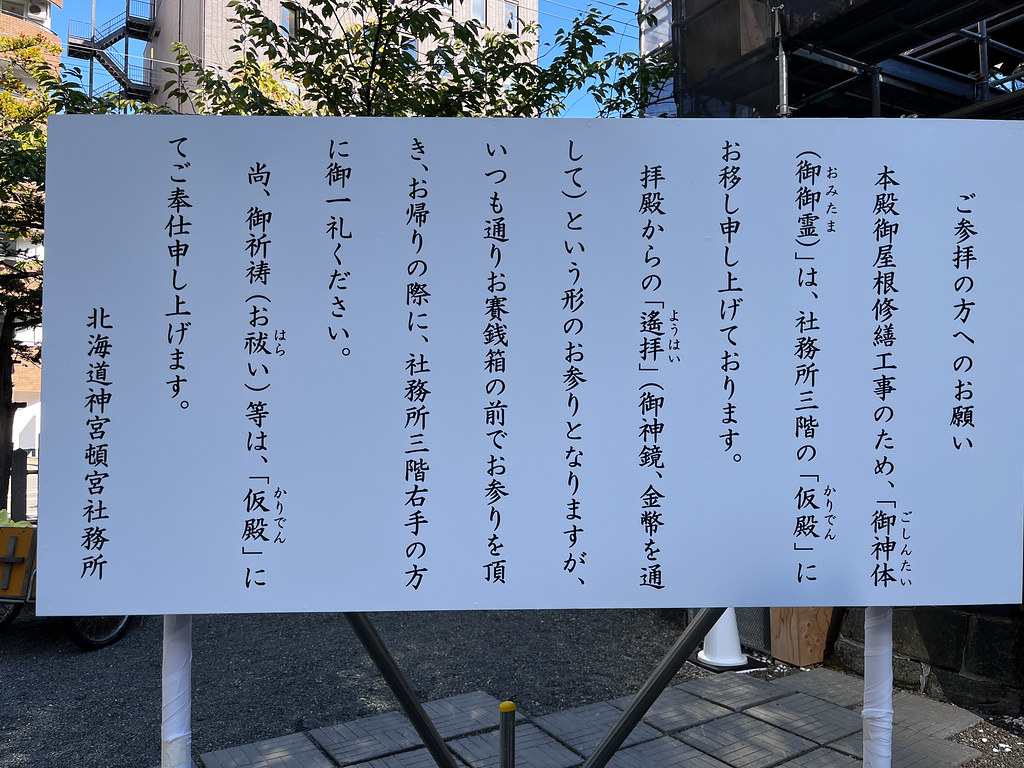
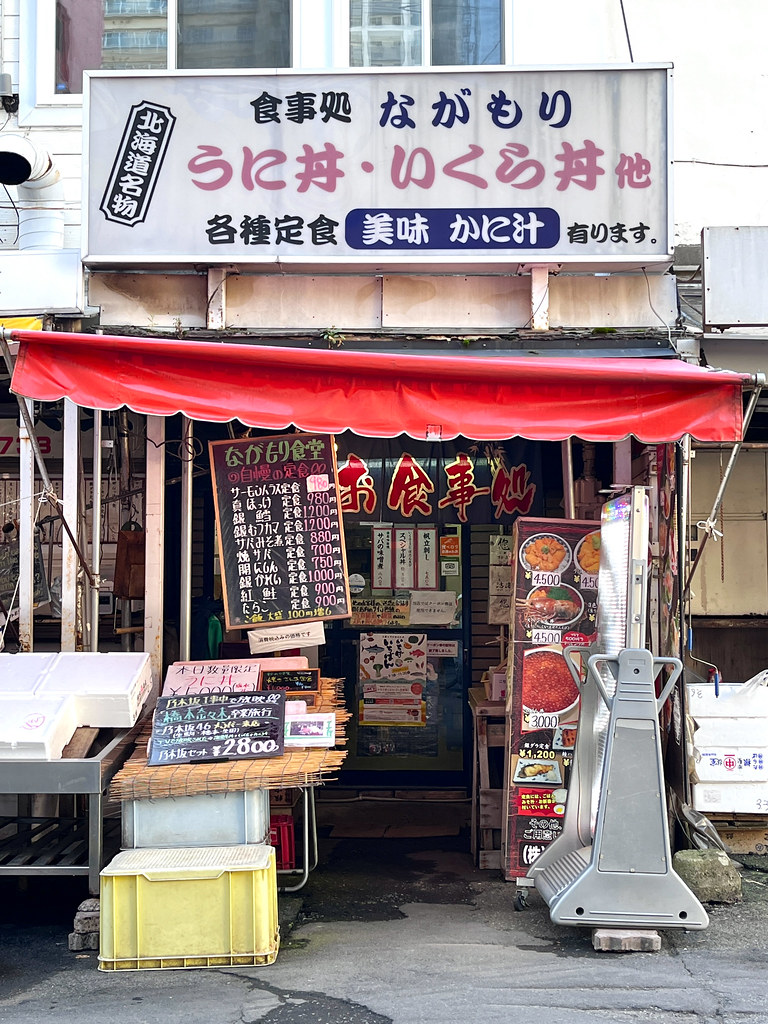
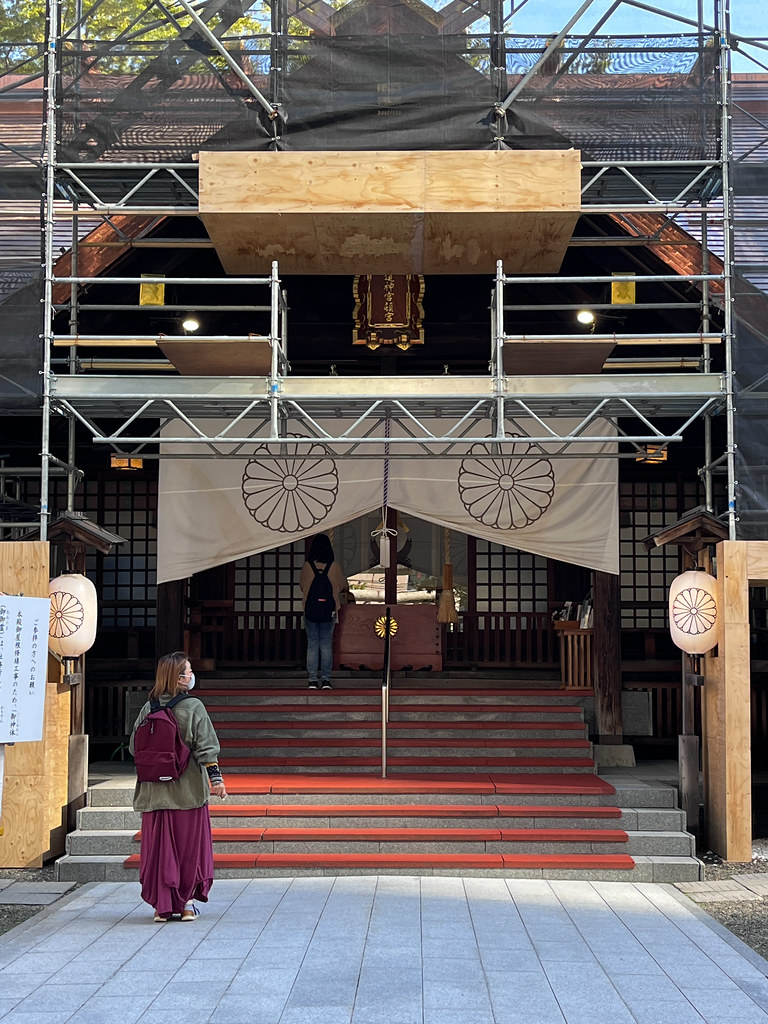
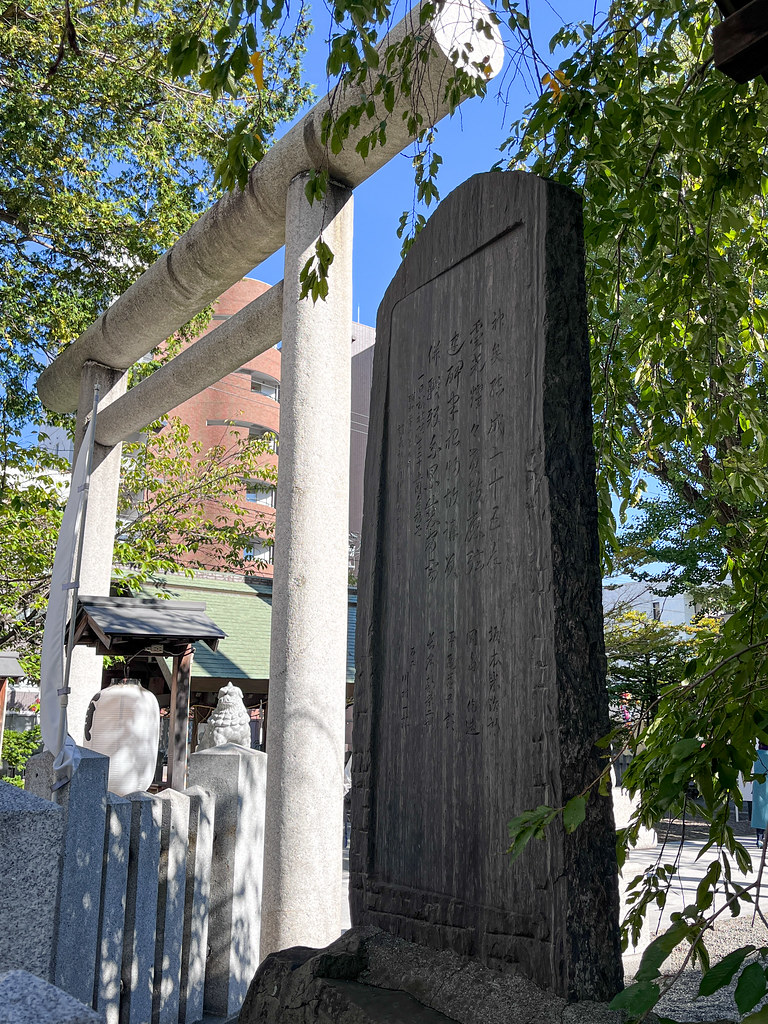
    On a positive side, I got the chance to eat a breakfast in the Japanese style and obtain a Sapporo postmark for my Postkard project. We also visited a small Shinto shrine to pray for better luck and no more unfortunate surprise on this journey before heading out on our bikes.
    The suburb of Sapporo is filled with separated recreational paths that make cycling through the area more pleasant. Today’s ride is mostly on a country road that has what I call a ‘semi-shoulder’ — meaning that there is enough of space for a bicycle even though it is not sufficient for a full-size car to park.

    Japanese cars are very kawaii (‘cute’): considered to be ‘light-weighted’, they are generally smaller than the North-American equivalents, including the mini-vans. They are quiet and relatively slow; the maximum speed allowed on those roads are often 40 or 50 km/h, instead of Canada’s 60 or 70 km/h. Plus most of Japanese drivers take the care to stay away from us, so it doesn’t feel threatening or scaring at all to share roads with cars.

    Japanese houses are also kawaii: they are tiny — even the country farm house is so — and interestingly painted. Japanese people seem to use up every meter square available to them, whether for growing crops or for building residences. I realised that farmers may not have space to welcome two travellers with a tent, as the parts of their land that are not farmland are the space in front of the entrance and the driveway. It doesn’t make sense to camp on these spaces. Moreover, their property is often unpaved, filled with sharp rocks that makes camping unpleasant.

    Camping is an issue in Japan. All campgrounds require reservation; we cannot show up on the day to ask for a spot. When I called at 3:30 pm a campground that was still 1.5 hour away, the staff asked us to arrive by 4:30 pm. I replied that it’s impossible because we were biking (thus cannot accelerate) but would arrive before the closing time that is 5pm, the staff appeared to be hesitating. From my Japanese courses I understand that hesitation means a no, so I told him we would go somewhere else. Japanese people are very indirect. They don’t refuse others with a clear no.

    Roadside stations (道の駅) which provide 24-hour heated washroom are all over the country. During the opening hours, they also serve as restaurants and touristic information centres. By the time the sun set, we arrived at the roadside station in Naie. We first asked the restaurant staff for a spot to pitch our tent. She replied that we couldn’t do so here and referred us to the campground whom I called earlier. Then we went to ask the station administrator for advice, he on the contrary showed us a grassy area where we could camp. So here we stayed!

    The full take — 23 more photographs from this day
    IMG_E1126 IMG_1128 IMG_E1134 IMG_E1136 IMG_1140 DSC_3195 IMG_1143 IMG_E1145 IMG_E1148 IMG_1150 IMG_E1153 IMG_1155 IMG_1158 IMG_1160 IMG_1167 IMG_1171 DSC_3199 IMG_1177 IMG_1181 IMG_1184 IMG_1189-Edit IMG_E1191 IMG_1164
    Ride replay on Relive
  • Day 01: Sapporo

    Date
    2022-10-12, Wednesday
    Distance
    6 km

    By the time we set up our bikes, it was already noon. We began our first bike ride in the heart of Sapporo, from our hotel to the train station tower nearby. There is a Republic of Ramen that groups many well-known ramen restaurants in one area with old-style decorations. I purposely ate my first authentic ramen wearing the Ramen Cat t-shirt that my friend bought for me from Taiwan.

    Biking in Sapporo is a pain. Most of the time people bike (without helmet) on the sidewalk that is designated to be shared by pedestrians and cyclists. I need to constantly avoid people so my speed is not very fast. Bikes are allowed on the outer edge of the street only when blue arrows are printed on the ground. Sometimes, the ride is so far from being smooth that I just want to bike in the street.

    This aside, the real pain is parking. There seems to be very strict rules about where one can lock one’s bike: in the designated areas only, everywhere else is marked with 駐輪禁止 (‘no bicycle parking’). Most of these parking lots are payable and reserved for residents. When going from place to place, we need to look around a long time to find a parking, then walk a long way to our destination. This is utterly inconvenient.

    Unlike in Montreal, Asian cities are filled with tons of overpasses at a crossroad for pedestrian to cross the street. Sometimes it’s even roofed. I wonder how the elderly population sees this. They seem to handle this inconvenience of climbing up and down the stairs with grace. In Montreal, pedestrians are the kings/queens, meaning that normally pedestrians get the top priority to cross a street. At popular intersection in downtown, every green light can often only allow 1-2 cars to turn.

    The night falls fairly early, at around 5:30 pm. Stores also close early at around the same time except restaurants. So we did nothing serious beside eating. The tourism industry seems to have waned considerably due to the pandemic; I didn’t see anywhere that sell postcards.

    I got back to our hotel before 9:30 pm to prepare for an online interview with a graduate student in art history whom I met in Montreal this summer. Very interested in my attempt at merging some aspect of mail art with the philatelic tradition, she asked a lot of details about the genesis of my idea, my Ukraine and Postkard project, and thought that my paying visit (which I called pilgrimage) to location and post office a performance. It was nice to speak to someone about my art.

    Tomorrow, all the way to Wakkanai and Cape Soya!

    Ride replay on Relive
  • Day 00: Montreal to Sapporo

    Date
    2022-10-10 to 10-11 (across different time zones)
    Distance
    0 km

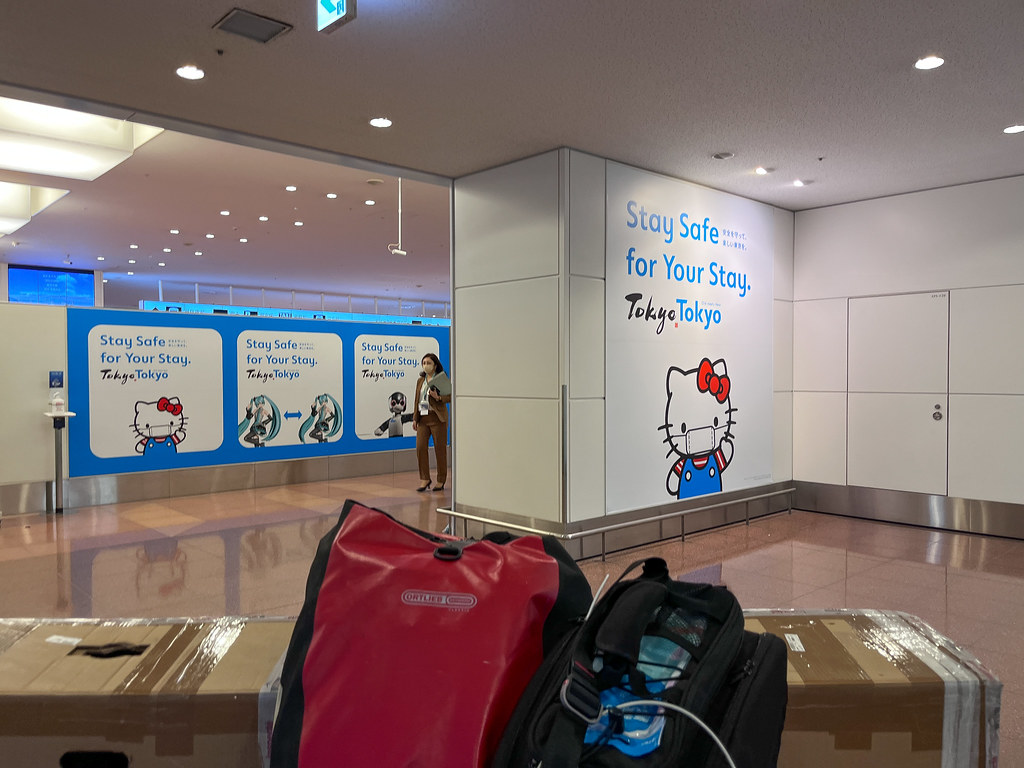
    Getting into Japan was tricky. I landed in Tokyo’s Hanade Airport on 11 October, which is the first day Japan’s boarder reopened to solo visitors. At the exit, there are a lot of people holding posters waiting to pick up their guests.

    A long line of quarantine staff wearing pink were waiting for us. The QR code Quebec government gave me for my vaccination statues didn’t work here, so originally I was forced to do a PCR test. The protocol was very different from the Canadian one: it required spiting a huge amount of saliva into a tube. While waiting for the result, I found a digital copy of my 4th vaccination proof which I showed them and they let me go. Japanese government requires that all foreign visitors must have received at least 3 vaccines and that the proof be clearly indicating the brand of the vaccines.

    When I went to pick up my luggages, the staff who recognised my red Ortlieb bag directed me to meet the other 3 staff who were looking for me with my bags and bike. Japanese people are really polite and apologetic, even if it’s not their fault, the first thing they do is to bow and apologise for keeping me waiting. This is much appreciated but can makes me uncomfortable. At the same time though, they are also very meticulous and obsessed with protocols and details: they required all visitors to fill out at least 3 forms, which I had only prepared one. So it took a long time for me to be officially entered in Japan.

    Due to reduced wait time, I was in such a rush to get to another side of the airport to get on my connecting flight on time that I ran up stairs and in the hallway. This is quite a scene to see as I appeared to be the only person doing so. Japanese people are very punctual, and running in a rush seems to be a breach of social conduct.

    At the Chitose Airport in Hokkaido I met up with my Taiwanese friend at 11pm. After many attempts at communication, we succeeded in booking a minivan to our hotel in Sapporo. Here English doesn’t work so well, I had to use my broken Japanese and Google translate to communicate.

    After much tribulations, we finally arrived safe in our hotel room (which is rather small for two people, but this seems to be the standard size of hotel room). Tomorrow we will get the necessary supplies then head to Wakkanai by train to start our bike trip.